
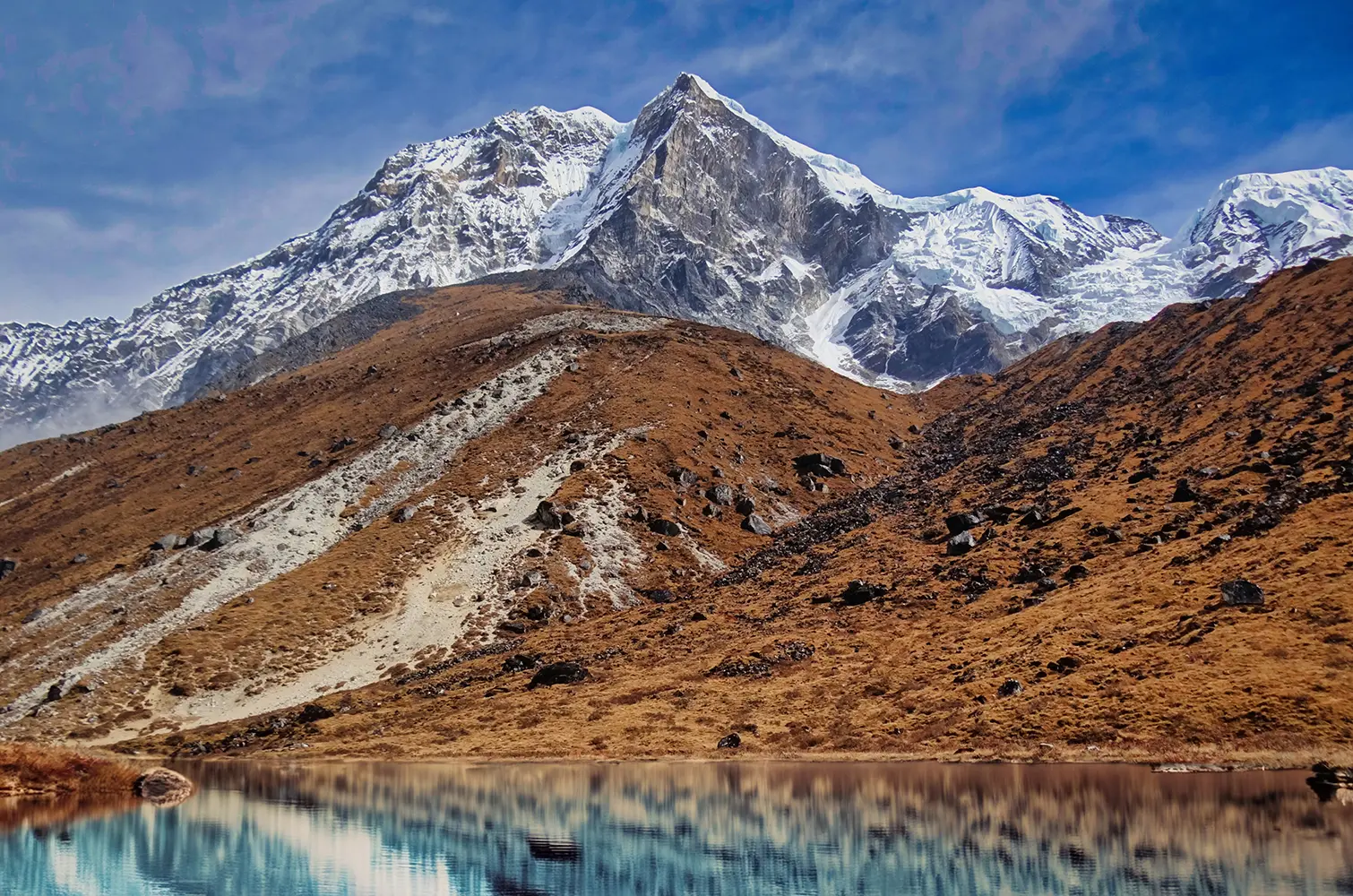
Searching for “Goechala Trek Death”, huh? Don’t worry, adventurer; it doesn’t mean you are heading towards your final destination. Nor does planning this trek mean you are walking into a death trap.
But if you typed those words, you probably have a real question behind them. Have people died on the Goechala trek? What caused it? And how dangerous is the trek today? The first answer is simple. Yes, they have. People have lost their lives on this trail, and that deserves a serious, honest conversation.
News reports counted at least three deaths on the route in 2025 alone. Yet news reports only show the part of the story that someone happened to write down. In Yuksom, where the trek begins, accidents and rescues have been talked about for as long as I can remember, whether or not a newspaper ever heard of them.
I cannot give you a neat number to quote. That does not mean the Grim Reaper or Yamraj is waiting for you on the Goechala trek.
My goal is to explain why such accidents happened on the trail, based on my own analysis of what we heard growing up, what the older trekking workers lived through, and how some of these tragedies might have been avoided.
What We Heard in Yuksom Before the Noise Box and Zombie Era Came
I was born in the 90s and grew up in Yuksom, the legendary town where the Goechala trek kicks off.
There was no Gen Z privilege back then: news of the mountains did not come through a social media scroll or digital HD news. It travelled through conversations and gossip among neighbours, families, trekking staff and anyone connected to the route.
Much of what we heard was about tourists who had fallen on difficult sections of the trail, a few of them while taking photographs. Some stories were about people who wandered away from their group or lost the trail, and a few were about people who went missing and were never found.
There were stories of trekkers who became seriously ill high up, and of the rescues that followed, with local people going up to help. Some of the people on those expeditions were local residents, so these never felt like distant events.
Camps were far away, and messages from them were limited. An accident or a death could be known across Yuksom and still never reach a newspaper or an online archive.
From what we heard in Yuksom growing up, serious accidents and deaths came up far more often in those earlier years than they do now.
Years later, I walked the route myself. I already knew its beauty and its dangers from the people who had told those stories. It is a strange feeling on a trail to admire a place and respect its risks in the same breath, because you were raised hearing about both.
How Trekking Looked in the Early 2000s
Some of my seniors worked on trekking expeditions as porters, cooks and guides. When they talk about those years, they talk about the hard days.
Some remember sleeping in caves when the campsites were crowded. Tourists might have proper sleeping bags and warm clothing, while the local staff had far fewer resources. They used to carry other people’s loads all day and spend the night in freezing temperatures with only moderate cover. Alcohol gave them a temporary, illusory warmth.
There was a time when local workers also carried their own food and cooked for themselves, and they did not necessarily eat what was served to the tourists. Today, agencies manage food for the staff as well.
Expeditions were organised differently too. Most groups walked from Yuksom to Tshoka in a single day, without stopping overnight at Sachen. Anyone who has done this trek can tell you how exhausting that would be. Today’s itinerary includes a night at Sachen, which helps your body adjust naturally to the altitude.
Camping near Samiti Lake was permitted, which put groups closer to the final approach, and that approach went much farther then. Groups did not have to stop at Viewpoint 1, where today’s treks turn around. They could carry on past Zemathang to the actual Goecha La Pass, and some went farther still.
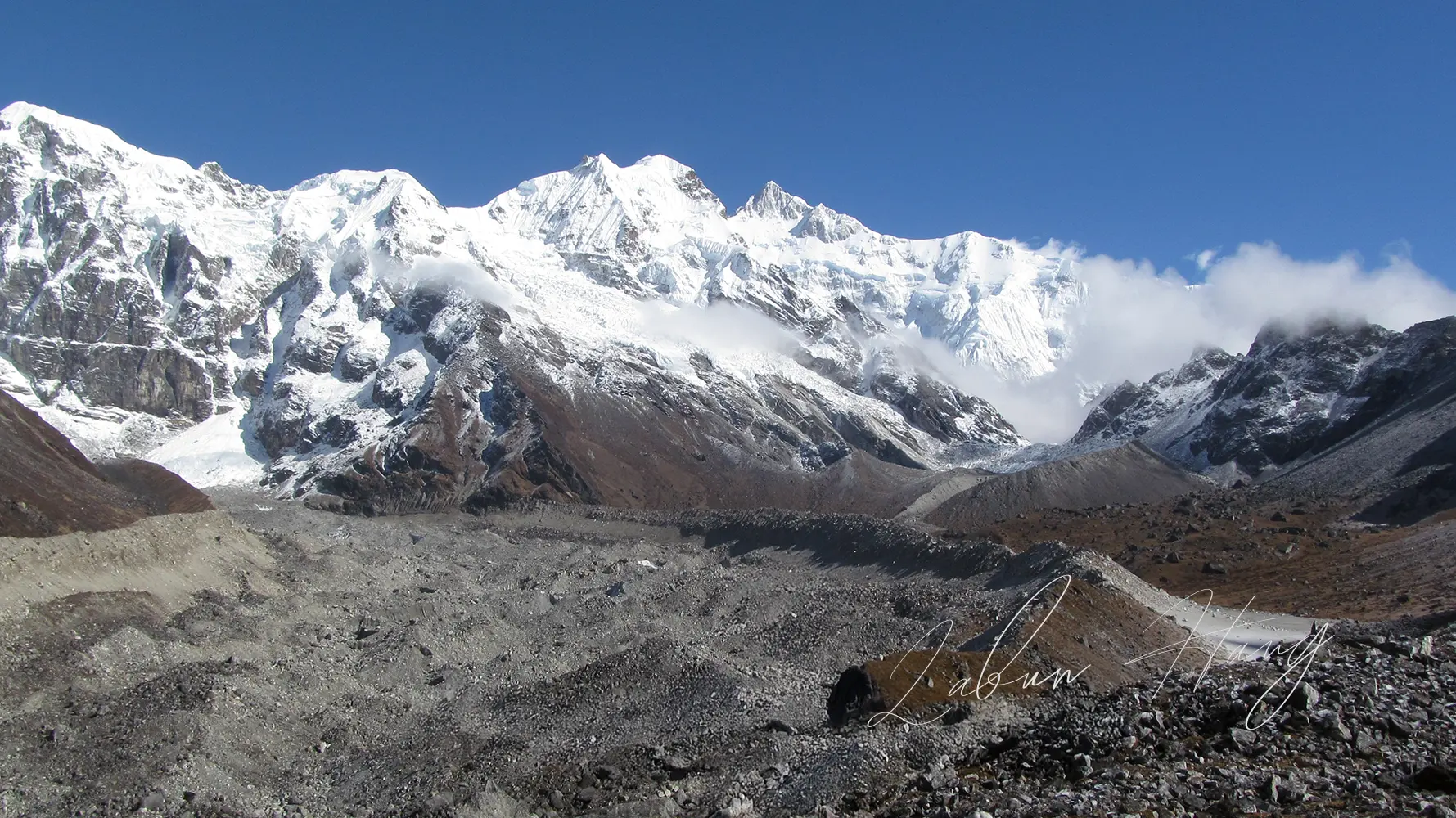
Beyond Viewpoint 1, the path drops to the sandy flats of Zemathang, and then the moraine begins. Groups climbed switchbacks on loose scree, picked their way through boulder fields and walked a narrow, exposed crest above the green Goechala lake before reaching Viewpoint 2 and the pass itself, close to 4,940 metres. Snow and ice on the stones made every step less certain.
Some expeditions did not turn around at the pass. They continued beyond it to a place locally known as Yangzhutha, camped there for the night, and only then began the journey back.
That meant more hours at high altitude, much of it higher than today’s endpoint, a night out in that high country, and the whole return across the moraine and past Viewpoint 1 still ahead of them.
Tourists and workers walked into the same weather on the same ground, and when someone was hurt far up the valley, help meant people walking up from the camps or from Yuksom, often a long way behind.
Is the Goechala Trek Safer Today?
In many ways, yes. Yuksom-based trekking organisers now provide better logistics.
What matters most for safety are the operational changes: experienced guides, itineraries planned around acclimatisation, proper first-aid kits, emergency oxygen on better-run trips, and an agreed way to send for help. Many operators now take these seriously, although standards vary.
Mobile network has reached a few patchy spots too, at campsites like Tshoka. I have also heard that Jio works at Dzongri Top and Daphla Gang, but I haven’t tested it yet. It is not exactly reassuring, but it is much better than the Stone Age.
The route has changed too. Trekkers are now permitted only as far as Goechala Viewpoint 1, at about 4,600 metres. Zemathang, the moraine and the pass are off the itinerary, so the expedition as a whole is shorter and stays on easier ground than the old one did.
Camping near Samiti Lake is also restricted today, but that does not make the final day any shorter. Most groups now start the viewpoint excursion from Lamuney, a camp farther down the valley. My Goechala Trek guide sets out the current route, camps and elevations day by day.
The trek is shorter, but its hardest day can still be very long. Groups leave in the dark from Lamuney, climb into colder, thinner air, reach the viewpoint, and still face the walk back. Depending on the itinerary, the return can continue through Thansing towards Kokchurung.
I have walked these stretches, and cold, height and accumulated tiredness do not care where the endpoint is printed on a map. I examine that viewpoint day in more detail in my Goechala Trek Difficulty article.
The camps and the route are much safer today, even if the mountain itself demands the same care.
Goechala Trek Deaths in 2025: What the Reports Say
PTI coverage in late 2025 described Suraj Kumar Tiwari’s death in December as the third on the route that year. Before him, according to The Sikkim Chronicle, Suman Debnath and a local resident of Gyalshing had died of acute mountain sickness on the same trail.
Suman Debnath, a 38-year-old customs officer from West Bengal, fell ill while climbing from Yuksom. According to the Gyalshing police chief, quoted in PTI reports, he complained of a severe headache, nausea, fatigue and breathlessness, then lost consciousness and died at Phedang, at about 12,000 feet, late on 18 November.
One report called him an experienced trekker. Police, porters and local guides climbed up to bring him down.
In the last week of December, Suraj Kumar Tiwari, a 45-year-old from Uttar Pradesh, was on an eight-day expedition. Fellow trekkers said he had finished the trek and was on the way back when, around nine in the morning near Kokchurung, he suddenly developed paralysis-like symptoms.
His companions and guide gave first aid, and local trekkers and residents helped carry him towards Yuksom. He died near Phedang, at about 12,100 feet. Early reports suspected low blood pressure, and his companions said he had no known health problems.
Some reports say he was descending the route, others say he was ascending when he fell ill. Both could be true if he was climbing out of the Kokchurung valley towards Phedang on the return journey, but the reports do not settle it. Nor do they give a medical finding, so none of these accounts should be treated as a final diagnosis.
What stands out to me in both incidents is that the trekkers were already being brought back after their health began to deteriorate. Unfortunately, neither survived the return journey. One breathed their last near Phedang, at approximately 3,650 metres, and the other at Kokchurung, around 3,700 metres. It was too late. Had the warning signs been recognised earlier, perhaps at Dzongri or Tshoka, the story might have been different.
How Dangerous Is the Altitude on Goechala?
Goechala is dangerous in the way every high mountain is. The air holds less oxygen as you climb, and your body needs time to adjust. Yuksom sits at about 1,780 metres. Tshoka, two walking days later, is close to 3,000. Dzongri is about 4,020 metres, and Goechala Viewpoint 1 is about 4,600.
The mildest form of altitude illness is acute mountain sickness, or AMS. It brings headache, nausea, dizziness, loss of appetite and unusual tiredness. Many people feel some of this and recover if they stop climbing and rest. It becomes dangerous when symptoms keep getting worse, or when fluid begins to build up in the lungs or the brain.
Fluid in the lungs is called high-altitude pulmonary oedema, or HAPE. Its warning signs include breathlessness even at rest, a persistent cough and growing weakness.
Swelling of the brain is called high-altitude cerebral oedema, or HACE. Its signs include confusion, clumsiness, trouble walking in a straight line and unusual drowsiness. Both can turn life-threatening quickly, and the CDC Yellow Book is clear that the answer is descent.
The itinerary itself matters more than many trekkers realise. Guidelines from the Wilderness Medical Society advise that above 3,000 metres, your sleeping altitude should rise by no more than about 500 metres a day, with a rest day every three to four days.
On the Goechala route, you sleep close to 3,000 metres at Tshoka and above 4,000 metres at Dzongri the next night. That is a jump of roughly 1,000 metres in one day. It is why the acclimatisation day at Dzongri exists, and why it is not spare time to be traded away.
Being fit does not cancel this. A strong walker can climb faster than their body can adapt, which is why feeling strong is a poor guide on the climb to Dzongri. The viewpoint day then starts in darkness from roughly 4,100 metres, and a trekker who is already tired or mildly unwell may find it too much.
If symptoms get worse, the only real treatment is to go down, even at night, without waiting for a better morning or a better view. Oxygen and a first-aid kit can support someone on the way, but they do not replace descent.
Illness also does not always stop when you start walking down. A trekker who feels unwell on the way up may be turned back by the guide, and the condition can still worsen on the return even as the altitude falls. That is why the decision to turn back works best when it is made early.
If you have a heart or lung condition, or have had serious altitude sickness before, speak to a doctor who knows high-altitude travel before you book.
Choices That Turn Trouble Into an Emergency
When I think back on the stories I heard growing up, many of the serious accidents involved a human decision as well as hard ground.
There were cases of people getting separated from their groups and losing the trail. Some ignored their guides’ instructions, while others ventured dangerously close to steep edges to take photographs. There were also incidents where trekkers continued climbing despite their deteriorating health. Alcohol was involved in some of the stories I heard growing up, including a few involving local people.
I believe carelessness and poor judgement lie behind a good share of the serious accidents on this trail.
On the old route those choices were made farther in, on harder ground and with less help nearby, so a mistake had fewer ways of being put right. The route is shorter now and the support far better, but people still make the same choices.
Saying “I’m fine” when you are not is one of the biggest risks on a high trail. Some trekkers hide a headache or a heavy tiredness because they have paid for the trip and fear being sent back.
Watch for signs of altitude sickness from Sachen onwards, not only higher up. If something feels wrong at Tshoka, Phedang or Dzongri, tell your guide and rest to acclimatise, and return if your condition keeps getting worse. A viewpoint can be visited another season.
The rule from altitude medicine is simple: do not go higher to sleep while you have symptoms, however minor they seem. Going on anyway is how a manageable problem becomes a rescue.
Alcohol is best avoided during the Goechala Trek. At high altitude, the body needs to breathe faster to compensate for reduced oxygen levels. Alcohol can interfere with this natural response, particularly during sleep. It also affects judgement and coordination, making it harder to recognise early symptoms of altitude sickness. For these reasons, drinking alcohol at high altitude introduces unnecessary risks.
Even on an organised Goechala Trek, trekkers need to pay attention to their food and water intake. At high altitude, appetite can decrease, and not eating or drinking enough can lead to dehydration, weakness and exhaustion.
Weather presents another risk. Rain and snowfall can make sections of the trail slippery, while prolonged exposure to cold and wind, especially in wet clothing, increases the risk of hypothermia. Falls are also a concern on steep or exposed sections of the trail, particularly when trekkers leave the safer path to take photographs.
Getting separated from the group is another serious risk on Goechala. In April 2025, a trekker from West Bengal was reported missing near Thansing. According to reports, he had been walking behind the rest of his group. Police and forest officials began searching for him, and NDRF and SSB teams later joined the operation.
The reports published in early May still described the search as ongoing. This is why trekkers should stay with their group and inform their guide before stopping or moving away from the trail. If you lose your way, stop somewhere safe and try to alert your group rather than wandering farther into unfamiliar terrain.
What Happens When Someone Cannot Walk Down
People often picture a mountain emergency as a phone call followed by an ambulance. On Goechala there is no road above Yuksom, and you should not count on mobile signal once you leave town.
Phedang, where both named trekkers died in 2025, comes on the third day’s walk of a standard itinerary, and it is still only part of the way in.
If a person is too weak to walk, someone has to help or carry them down. The guide must assess the patient and organise the group.
Porters and other workers take turns supporting or carrying, often through mud, steep steps, rain or cold. Word has to reach nearby camps and Yuksom for more hands. A day that was meant to be a walk becomes an evacuation that can last many hours.
Do not plan your Goechala Trek around a helicopter rescue. I have come across websites claiming that helicopter rescue services are available along the trail. Whenever I read such misleading information, I feel like catching hold of the writer and dipping him in a drum of water! What exactly do they imagine? A helicopter hovering over the mountains, with someone hanging from it like Tom Cruise or Akshay Kumar performing a stunt in an action film?
Yuksom has a helipad, but there are no established helipads at Dzongri, Thansing, Lamuney or Goechala Viewpoint 1. The demand for helipads further along the trekking route has been raised repeatedly during local meetings, but nothing has materialised so far. Even if a helipad is constructed in the future, that does not mean a helicopter will be stationed at Yuksom. It would still need to be arranged from elsewhere, possibly Gangtok or Bagdogra, near Siliguri.
Then comes the biggest challenge: weather. The higher reaches of the Goechala Trek are frequently affected by fog, mist, low clouds and sudden changes in weather. Helicopter operations depend on visibility, wind conditions, aircraft availability and the suitability of the terrain. You cannot expect a helicopter to arrive in the middle of the night simply because an emergency has occurred.
Helicopter evacuation may be possible under exceptional circumstances, but it is not a regular rescue service that trekkers can depend on. In most emergencies, the practical option is to bring the injured or sick person down with assistance from guides, porters and local rescuers, sometimes using a stretcher or carrying them along the trail.
Reaching Yuksom is not the end of the journey either. The town’s Primary Health Centre has improved a great deal, as I wrote in my Yuksom guide, but it is not a major specialist hospital. Serious cases may be sent on to Gyalshing or Gangtok, which means more hours on the road.
Guides, porters and cooks do far more than carry tents and cook meals. When someone becomes seriously ill, their knowledge of the route and their own strength become the rescue system.
How Goechala Can Become Safer
Better equipment and more organised itineraries have already changed this trek. What still needs work is what happens when something goes wrong far from the road.
Communication comes first. Every team needs an agreed way to raise the alarm and to reach the camps ahead and behind. After the third death in 2025, tourism stakeholders in Yuksom asked authorities to strengthen medical facilities, emergency response and rescue infrastructure along the Dzongri-Goechala corridor. They know the route best, and I agree with them.
Then comes medical support on the trail itself. Almost all guides and trekking staff on this route are trained and certified, and travel agents send reputed, certified guides with their groups.
What the route still lacks is basic medical infrastructure along the way. I would like to see the government place essential facilities such as stretchers, medicines and portable oxygen at campsites like Tshoka, Dzongri and Thansing, along with trained medical practitioners stationed there. Skilled guides could then count on proper medical help at the next camp.
The safety of local workers belongs in this conversation too. A good expedition provides proper clothing, sleeping equipment, meals and reasonable loads for porters and cooks, not only comfortable tents for paying guests. The days of staff sleeping in caves may be behind us, but looking after the crew remains just as important today.
Price and competition matter as well. Today, almost everyone wants a cheaper trekking package, and travel agents compete to secure bookings by offering the lowest possible rates. But tourists rarely see what happens behind the scenes. Lower prices often mean tighter budgets for equipment, meals, camping facilities and the number of staff accompanying the group.
I have personally seen how this affects trekking teams on the trail. Guides, porters and kitchen staff often work under pressure, but hesitate to speak about their difficulties for fear of losing future employment. When an operator charges more to arrange better logistics, experienced guides, adequate staffing and proper facilities, that additional cost serves a purpose. Trekkers should understand what they are paying for rather than choosing a package simply because it is cheaper.
Before you book, ask how many nights you will spend at Dzongri, what the team carries for emergencies, how it communicates and what the staff sleep in. A good operator will answer without discomfort. My Goechala Trek guide explains what else to compare before you pay.
Should You Still Trek to Goechala?
Yes, if you are healthy, reasonably fit and willing to be guided. Before you book, be honest with yourself about your health. Goechala is not the right trek for you if you:
- suffer from a chronic critical illness or asthma
- have chronic muscle or bone problems in your legs or back
- are under serious medical review or taking medication for a serious condition
- are pregnant
Fitness and experience matter too. Goechala is not a good first Himalayan trek. Before you come, you should be able to walk five or six hours on steep, uneven trails with a daypack, and do it again the next day.
If you have had serious altitude sickness before, or you are carrying a recent injury or illness, speak to a doctor and consider postponing. My Goechala Trek Difficulty article explains how to train and how to judge whether you are ready.
On the trail, stay with your group, do what the guide asks, and keep back from the edges of slopes and ridges, however good the photograph looks. Leave the alcohol for Yuksom.
Tell the guide at once about a headache, nausea, breathlessness or unusual weakness, and accept that the day may end before the viewpoint.
Over the years, I have led more than 30 Goechala treks, guiding everyone from children to senior trekkers. From my experience, hardly 1% of the people I guided failed to reach the final viewpoint, and none of those cases involved a critical medical emergency. Some turned back from Samiti Lake because of knee problems. Others preferred the warmth of their sleeping bags to walking in the freezing darkness before sunrise. A few simply lost the motivation to continue, while others were unlucky with the weather after choosing the wrong season.
Having witnessed all this myself, I can confidently say that Goechala is a demanding trek, but it is certainly achievable with proper preparation, good guidance and sensible decisions along the way.
My advice is to book directly with a reliable local trekking operator based in Yuksom rather than through third-party booking agencies or business-to-business service providers. Know who is actually organising your expedition and who will be guiding you in the mountains.
Thousands of beautiful memories have come out of these mountains, alongside the unfortunate stories I have discussed here. Enjoy the journey, respect the risks, and listen to your guide. After all, the purpose of your adventure is to return home with wonderful memories, just as countless trekkers have done before you.

Conversation
No comments yet. Share your thoughts and start the conversation.