
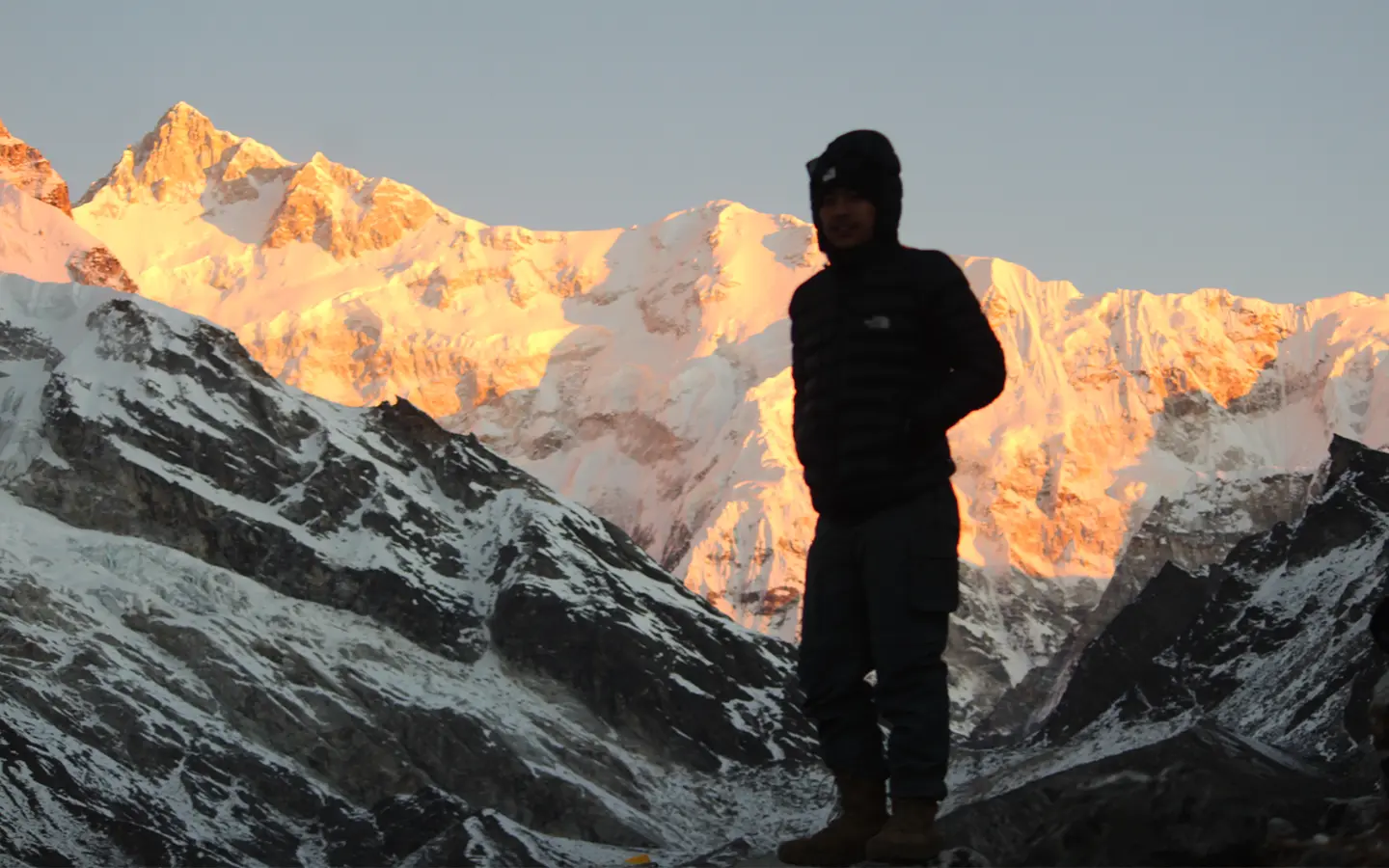
Goechala is a difficult high-altitude trek, but it does not require technical mountaineering skills in normal trekking conditions. Its main challenges are the steep ascent to Dzongri, walking for several consecutive days, cold and unpredictable weather, and the long journey towards Goechala Viewpoint 1 at approximately 4,600 metres.
If you have already completed multi-day Himalayan treks and have trained for sustained uphill walking, Goechala can be a realistic next challenge. If this would be your first trek, build experience on a shorter route before attempting it.
The following assessment focuses on where the route becomes difficult, what preparation helps, and how to judge your readiness. For the complete route, itinerary, permits and costs, see the Goechala Trek guide.
How difficult is the Goechala trek?
Goechala is a difficult trek because you walk for roughly eight to ten days, depending on the route. You also spend several nights at high altitude.
The trail crosses steep forests, open valleys and rocky ground. Not every day is equally hard. Some parts feel gentle, while others demand much more effort.
| Factor | What to expect |
|---|---|
| Overall difficulty | Difficult, non-technical trek |
| Starting point | Yuksom, approximately 1,780 m |
| Usual highest trekking point | Goechala Viewpoint 1, approximately 4,600 m |
| Duration | Commonly 8–10 trekking days, itinerary-dependent |
| Approximate distance | Often reported around 70–90 km for the return route; measurements vary |
| Hardest uphill section | Tshoka to Dzongri |
| Most demanding full stage | Viewpoint excursion and return |
| Experience recommended | Previous multi-day mountain trekking |
There is an important difference between the pass and the usual trekking destination. Goechala Pass is around 4,940 metres, but most trekkers aim for Viewpoint 1, at about 4,600 metres.
Not everyone goes to the pass itself. Before booking, confirm which viewpoint or turnaround point is currently allowed.
A local perspective on the difficulty
I am from Sikkim and have completed more than 50 treks, most at high altitude. I also worked at times as a high-altitude trek leader, helping groups on tough mountain trails.
I no longer lead treks or offer guiding services. I write about these routes to share what I learned from my time on the trail.
What I learned is that distance alone tells you very little. Someone who can walk far on a flat road may still struggle with a steep climb at altitude.
Another trekker may walk more slowly but manage the climb well by keeping a steady pace. Fitness, time to adjust to altitude and good judgement all matter.
What makes the Goechala trek difficult?
1. The steep climb from Tshoka to Dzongri
The ascent from Tshoka, at approximately 2,960 metres, to Dzongri, near 3,990 metres, is one of the trek’s biggest physical tests. It covers roughly 8–9 kilometres on many itineraries, but includes around 1,000 metres of net elevation gain. That is substantial climbing in a single day.
The route heads through rhododendron forest towards Phedang, continues uphill towards Deorali, then reaches Dzongri after a change in gradient. Conditions vary by season, and the exact route distance depends on where the day’s walk begins and ends.
You need to manage your energy rather than chase the fastest walker. Short breaks, a steady pace and adequate time for the ascent are more useful than repeatedly pushing to exhaustion.
2. Altitude and acclimatisation
As elevation increases, atmospheric pressure falls, so less oxygen is available with each breath. Uphill walking becomes harder and recovery may feel slower. Sleeping near 4,000 metres can also be uncomfortable for people new to altitude.
The climb from Tshoka to Dzongri brings a large gain in sleeping altitude. The itinerary should allow time to get used to the height, rather than rush towards the viewpoint.
An acclimatisation day at Dzongri may include a walk towards Dzongri La, around 4,400 metres. Trekkers then return to sleep at the Dzongri campsite.
Dzongri Top, at about 4,200 metres, is a different viewpoint. It is not the same place as Dzongri La. Even after an acclimatisation walk, you must watch for signs of altitude sickness.
The route is not a continuous ascent after Dzongri: trekkers generally descend towards Kokchurang before climbing again towards Thansing. Understanding these changes matters when comparing day-by-day elevation charts.
3. The long walk to Goechala Viewpoint 1
For many trekkers, the viewpoint excursion is the hardest overall stage. It commonly starts before dawn, from Thansing or the Lamuney area depending on the itinerary. The route passes towards Samiti Lake before climbing towards Goechala Viewpoint 1.
The higher trail is open, uneven and often rocky. Snow, frost or ice can make it much harder to walk safely.
Keep enough energy for the return. The length of the viewpoint day depends on where you start and where you finish. There is no single walking time that fits every itinerary.
4. Fatigue over several consecutive days
A hard day hike is not the same as walking for more than a week. At Goechala, you may sleep in a cold tent, wake before sunrise and walk again with tired legs.
Altitude can also affect sleep and appetite. Even a fairly easy stage can feel harder towards the end of the trek.
This is why walking endurance matters more than a single impressive running time. Preparation should include long hikes and some back-to-back walking days, not only short, intense workouts.
5. Terrain, weather and descent
The lower trail includes forest paths, roots, steps, stream crossings and sections that can become slippery after rain. Higher up, rocky paths and exposed ground demand more careful footing. Downhill walking can also be hard on the knees and thighs, particularly when fatigue has built up.
Spring often brings wetter conditions on the lower trail, while late-autumn mornings can be considerably colder. Neither season guarantees easy walking. Weather can change the difficulty of a familiar route from one day to the next.
Where does Goechala get difficult?
Explore the climbs, dips and long high-altitude stages. Select a stop to see the challenge that matters most.
A deceptively uneven start
The forest path repeatedly rises and falls before the higher climb begins. An apparently modest net altitude gain does not mean an effortless opening stage.
Start at a pace that lets you talk comfortably. Use this section to settle into your walking rhythm.
The forest climb becomes real
The ascent via Bakhim becomes more sustained. Wet roots, steps and steep bends can make a short-looking distance feel longer.
Keep your footing deliberate on damp sections and avoid pushing hard before the Dzongri climb.
The largest uphill test
The climb via Phedang gains roughly 1,000 metres. Its combination of steep walking and a major increase in sleeping altitude makes it a decisive stage.
Maintain a steady ascent and choose an itinerary that gives you adequate time to acclimatise at Dzongri.
Lower altitude does not mean easier walking
You descend towards Kokchurang before climbing again. The finishing altitude hides the amount of descending and reascending along the way.
Protect your knees on the descent and budget energy for the climb back towards Thansing.
A shorter day at serious altitude
Where Lamuney is included as a camp, the walking may be shorter, but thin air, cold weather and disturbed sleep still demand attention.
Use the lighter schedule for recovery. Some itineraries skip Lamuney, so check your actual camp plan.
The hardest overall effort
An early start and rocky high-altitude ground lead towards the viewpoint. The challenge is not over when you reach it: the return still needs time and energy.
Confirm the day’s distance from your actual camp, carry a headlamp and warm layers, and follow the guide’s turnaround decisions.
Which is the hardest day of the Goechala trek?
Tshoka to Dzongri is usually the toughest sustained uphill day. The elevation gain is what makes it challenging, even though the distance is relatively short.
The Viewpoint 1 excursion is usually the hardest full day. You start early, walk at greater altitude and travel over rough ground. You still have a long return after reaching the viewpoint.
Someone who struggles with steep climbs may find the Dzongri ascent harder. Someone who struggles with cold or long walks may find the viewpoint day harder.
Who should not attempt the Goechala trek?
The standard Goechala route does not require technical climbing. Even so, it is not suitable for everyone. Age and strength alone cannot tell you whether you are ready.
You need to walk for days at high altitude. You also need to cope with cold camps and be prepared for a hard descent if you become ill or injured.
People without adequate trekking preparation
If you have never spent several hours walking uphill on rough ground, gain that experience before attempting Goechala. The same applies if you struggle to recover after a long hill walk.
Running and weight training can help, but they do not fully prepare your legs and feet for several days on mountain trails.
Try a shorter trek first. It will help you learn how you handle steep climbs, cold camps and long descents.
People with unstable or serious medical conditions
Do not treat Goechala as a test of willpower if you have an unstable heart or breathing condition. A serious medical problem can become more dangerous at high altitude.
Unstable chest pain, poorly controlled asthma, significant heart failure and severe lung disease can make this trek unsafe.
Having asthma, diabetes or high blood pressure does not always mean you must avoid high-altitude trekking. But your condition needs to be well managed, and the advice will depend on your health.
If you have a heart or lung condition, a serious medical history or a need for medical equipment, speak to a clinician who knows high-altitude medicine before booking. Some conditions make ascent unsafe. Others call for a careful plan. The CDC Yellow Book explains these risks in more detail.
People with a history of severe altitude illness
If you have had serious altitude sickness before, do not assume you will be safe next time just because you are fitter. This includes high-altitude pulmonary oedema (fluid in the lungs) and high-altitude cerebral oedema (swelling in the brain).
Seek medical advice before planning another high-altitude trek. You may need a different ascent plan. Being physically fit does not prevent altitude sickness.
People who are ill, injured or insufficiently fit at departure
A knee injury, recent illness or trouble completing training hikes may be a reason to delay your trek. Pain that gets worse when you walk downhill is especially important on this route.
Do not arrive in Yuksom hoping to build the fitness you need along the way. Prepare before you leave home.
People choosing a rushed itinerary or unwilling to turn back
A rushed plan can make Goechala harder and less safe. The route gains height quickly on the way to Dzongri. Cutting out time to adjust to the altitude is a poor trade-off.
Starting the viewpoint walk from Thansing, instead of Lamuney, may also make the day longer and more tiring. Check the actual camp stops before choosing a shorter package.
No itinerary can promise success. You must also be willing to turn back. If reaching Viewpoint 1 matters more to you than your health or the guide’s advice, reconsider the trek.
Age alone is not a reliable exclusion rule. An older trekker with suitable health and mountain experience may be better prepared than a much younger beginner. Judge readiness through health, training, experience and the actual itinerary, not a single age number.
Can beginners do the Goechala trek?
A very fit beginner may complete Goechala, but it is not a good choice for a first Himalayan trek. Gym fitness alone cannot prepare you for days of rough trails, cold camps and sleeping near 4,000 metres.
Even a strong, confident person should think carefully about the health and experience limits described above.
If you have never completed a multi-day mountain trek, build experience first. Sandakphu may be a useful progression, while a shorter Dzongri itinerary can introduce parts of this same route. Dzongri is still a demanding high-altitude trek, not an easy beginner walk.
You do not need to be a professional athlete. You do need a sound endurance base, realistic expectations and an itinerary that allows appropriate acclimatisation.
How fit should you be for Goechala?
Before Goechala, aim to walk on uneven, hilly trails for five or six hours with a daypack. You should also be able to walk downhill with control.
Ask yourself whether you could do another long walk the next day. These are training goals, not a medical clearance or a promise that you will finish the trek.
A practical training plan
- Build aerobic endurance: Walk briskly, cycle, swim or jog several times each week, increasing duration gradually.
- Train uphill and downhill: Choose hills or stairs and pay attention to controlled descents as well as climbing.
- Strengthen your legs: Squats, step-ups, lunges and calf raises help with stability and repeated climbing.
- Practise with a daypack: Take longer hikes carrying the essentials you would use on the route.
- Try consecutive hiking days: Learn how your legs recover when you have to walk again the next morning.
If you are already active, roughly eight to twelve weeks of focused preparation may help. If you have not exercised regularly, begin earlier and build fitness progressively. The aim is to arrive in Yuksom prepared, not exhausted from training.
A practical Goechala readiness check
Before paying for a departure, be able to answer the following questions honestly. This is a practical preparation check, not a medical test or a promise that altitude sickness will not occur.
- Can I complete a five- or six-hour hilly walk? Include steep climbing, uneven footing and a daypack, not just a flat road.
- Can I do another substantial walk the following day? Recovery matters because Goechala demands effort over several consecutive days.
- Can I descend safely when tired? The long downhill sections can be harder on the knees and thighs than the climb.
- Have I previously managed mountain conditions? Consider cold camping, an early morning start, wet trails and basic facilities.
- Am I prepared to stop or descend? I should be able to report symptoms promptly and accept my guide’s decision even if it ends my viewpoint attempt.
If several answers are no, spend more time training or complete a shorter mountain trek first. If your uncertainty is medical rather than physical, seek individual high-altitude medical advice instead of relying on this checklist.
Altitude sickness: what trekkers need to know
Acute mountain sickness can affect people of different ages and fitness levels. Warning signs include headache, nausea, dizziness, unusual tiredness and loss of appetite after ascent. Do not automatically dismiss them as ordinary trekking fatigue.
Do not ascend to sleep higher when experiencing symptoms of altitude sickness. Worsening symptoms require descent and appropriate medical help. Confusion, difficulty walking steadily or breathlessness at rest are particularly concerning signs requiring urgent action.
Tell your guide about symptoms early. Before travelling, discuss relevant health concerns and possible preventive medication with a clinician familiar with high-altitude travel. Established guidance is available in the CDC Yellow Book’s altitude illness chapter.
What happens if you need to turn back?
Turning back from Goechala is not like calling a vehicle from a roadside trail. There is no road for vehicles beyond Yuksom.
From a high camp such as Dzongri or Thansing, reaching lower ground can still take hours. The path may be steep or wet.
If you become ill or injured, you may need help from the guide and a ground rescue team.
This is why I would take signs of altitude sickness at Dzongri seriously. Pushing farther towards Thansing may make the return more difficult.
The route has both climbs and descents. Going back is not always an easy downhill walk. Trekkers should not rely on helicopter rescue.
Before you start, ask the registered trekking organiser who decides when a trekker must turn back. Also ask how the team will contact others during an emergency.
Find out what ground rescue help is available and how an injured person could be brought towards Yuksom. You cannot remove every risk, but you should know the plan before an emergency happens.
Does the season change the difficulty?
April to May: The rhododendron forests are a highlight, and conditions are often milder than late autumn. However, rain and mud can make the lower sections slippery, and snow may remain higher up.
October to November: Clear mountain views are an attraction, but higher camps and the early morning viewpoint excursion can feel significantly colder. Frost and ice are possible.
Neither season is automatically easier. Trail conditions and visibility depend on the actual weather during your trip. Always allow for changes to the itinerary.
How does Goechala compare with other Himalayan treks?
Goechala goes higher than Sandakphu and usually involves more days of camping in remote areas. It also goes farther than the Dzongri trek and adds the long walk towards Viewpoint 1.
Compared with Kedarkantha, Goechala usually means more days on the trail and a higher destination.
These comparisons describe the overall commitment rather than every individual day’s difficulty. A short, steep stage on another trek can still be demanding in its own way.
Three questions to ask before choosing an itinerary
- Is there enough acclimatisation time around Dzongri? Compare the sleeping altitudes, not just the number of advertised days.
- Where does the viewpoint walk start and finish? The difference between starting at Thansing and Lamuney can affect the longest day’s demands.
- What is the descent and evacuation plan? Ask how the guide handles illness, changing weather, communication and turnaround decisions.
The trek starts and finishes in Yuksom. For the trailhead’s location and practical local context, read my guide to Yuksom. For the day-by-day route and other planning details, see the complete Goechala Trek guide.
Frequently asked questions
Is Goechala a technical trek?
No technical climbing is normally required on the standard trekking route in suitable conditions. However, it is still a difficult high-altitude trek. Snow, ice and adverse weather can increase the hazard substantially.
Is Goechala harder than Dzongri?
Yes, as a complete trek. Both share the challenging ascent towards Dzongri, but Goechala continues into higher terrain and adds further trekking days and the long viewpoint excursion.
How many days do you need for Goechala?
Many itineraries take about eight to ten trekking days from Yuksom and back. Exact duration depends on camp choices, acclimatisation days, weather and the operator’s route.
Can you reach Goechala Pass itself?
The usual trekking objective is Goechala Viewpoint 1, near 4,600 metres. The actual pass is higher, around 4,940 metres, and should not be assumed accessible as part of a standard itinerary. Confirm the current authorised route with the relevant local authorities and operator.
Is helicopter rescue available on the Goechala trek?
There is no regular helicopter rescue service you can count on at Goechala’s remote camps. Do not assume you can be flown out if you become ill or injured.
Most emergencies require help on the ground, such as an assisted descent or stretcher transport. The time needed depends on the weather, your location and the help available. Rare official air operations are not a guaranteed rescue option.
What if I develop altitude sickness?
Tell your guide immediately and avoid ascending further to sleep at a higher altitude. If symptoms worsen or serious warning signs appear, prompt descent and medical assessment take priority over reaching the viewpoint.
Do you still lead Goechala treks?
No. I am from Sikkim and have completed more than 50 treks, most at high altitude. I also worked as a trek leader in the past.
I no longer offer trekking or guiding services. I wrote this article to help readers prepare, not to advertise treks.
Final verdict: is the Goechala trek worth attempting?
Goechala is difficult primarily because it combines a steep climb, several days of walking and prolonged effort at altitude. The ascent to Dzongri tests uphill stamina; the journey towards Viewpoint 1 tests endurance, patience and judgement.
If you have experience on mountain trails, train consistently and choose a sensible itinerary, it can be an exceptional trekking goal. If this is your first Himalayan trek, gain some experience before committing to the full route.
The best preparation is neither fear nor overconfidence. Learn what the route demands, build the endurance to meet it and be prepared to turn back if conditions require it.

Conversation